
This is something that came out of chatting with my friend Matthew last week.
I was giving a talk to a group of business analysts on writing effective user stories. We had gone through the theory, the examples, the whole spiel. But near the end, I decided to show them something unexpected.
“Let’s pretend you all are my stakeholders,” I said. “You’ve described a feature, and now I’m going to show you what I understood.”
I walked over to the whiteboard and started sketching the screen — basic layout, a few key interactions, a button here or there. I’m a visual thinker, so this helps me solidify what I understand.
Once I had that on the board, I opened up ChatGPT on my phone, hit record, and narrated what I was seeing:
“We’re thinking about a feature to solve the following problem… it should show this information here… when users click this, that should happen…”
Then I snapped a picture of the whiteboard.
In that moment, I wasn’t doing anything fancy. I was just combining a drawing, a voice prompt, and an image to convey intent.
I dropped all of that into ChatGPT and told it:
“Write user stories based on this. Use the format I normally use — title, description, acceptance criteria with Given/When/Then.”
Boom. Stories generated. Clear, structured, relevant.
I copied the generated stories and pasted them into Google’s AI Studio. Within a couple of minutes, we had a working prototype of the app we had just talked about.
That moment — the sketch, the narration, the AI response, the app on screen — all took under five minutes. It broke down resistance not through persuasion, but through demonstration.
This wasn’t a hypothetical. It was real and fast.
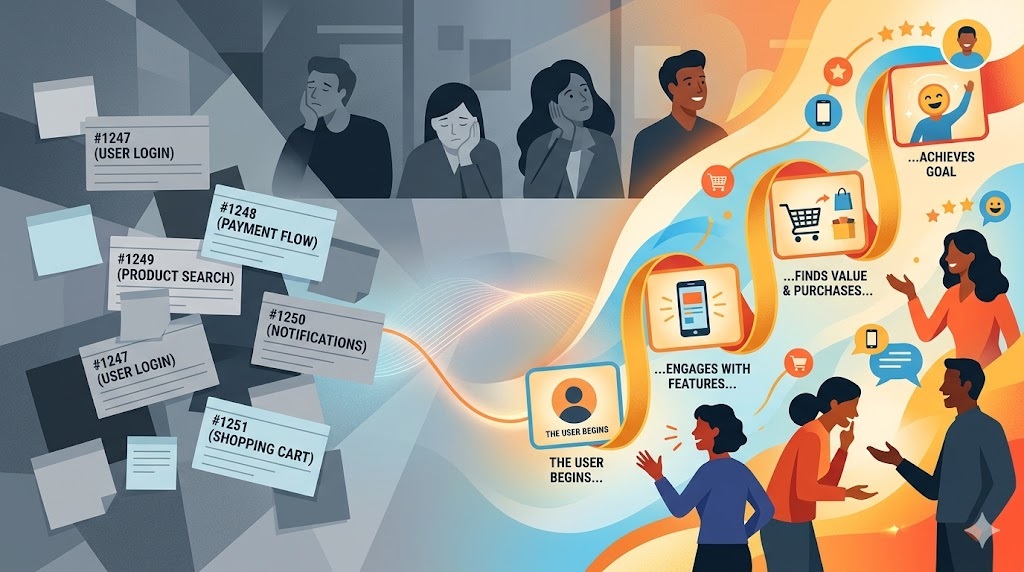
We spend so much time trying to get stakeholders to see what we mean. We use words like flow, experience, interaction, and friction. But sometimes the words don’t land. The conversation stays stuck in abstraction.
This approach changed the game.
When people can see the thing, when they can interact with it and start saying, “Oh, can we move this here? Could it also do that?” — they’re in. They’re engaged. And most importantly, they’re contributing.
I’m borrowing Temple Grandin’s “30-Second Wow” concept for this. Show something concrete, fast. Let the visuals make your point for you.
This isn’t about being flashy. It’s about unlocking collaboration.
The moment people realize that their words, ideas, and drawings can become real, the dynamic shifts. Resistance drops. Curiosity rises. Now we’re building together.
And it all starts with: sketch, speak, snapshot, go.
Want to try your own 30-Second Wow? Next time you’re stuck explaining a feature, try drawing it, narrating it, and feeding it into your favorite AI tool. You might just watch the room light up.


Leave a Reply to Stop Explaining and Start Showing | Claudio Lassala's BlogCancel reply