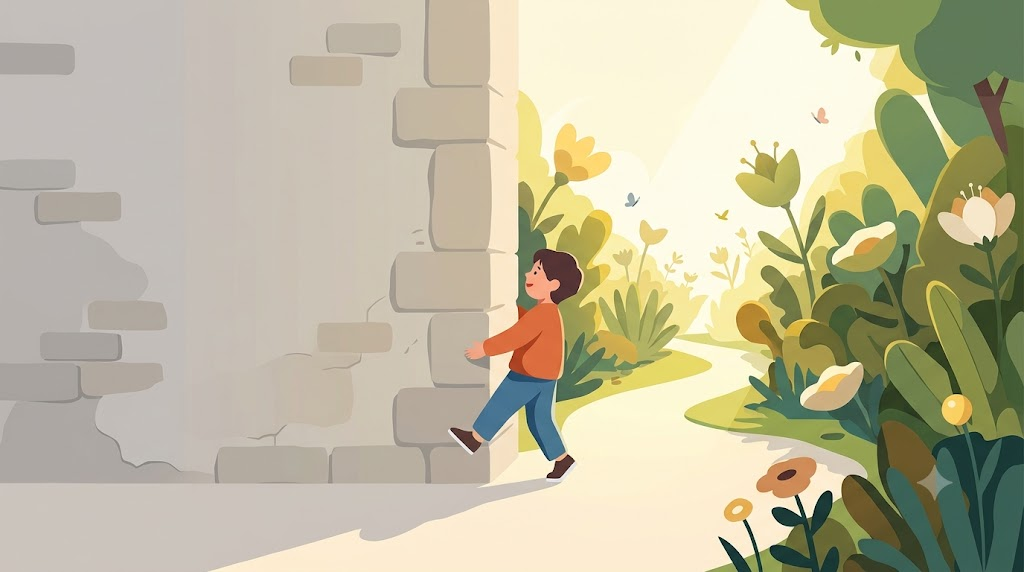
Years ago, I started doing five minutes of language practice most days. I never told anyone. It did not feel like a real goal. It was just a tiny experiment. Then we traveled to Spain, and my wife watched me order food and ask directions in Spanish. She looked at me like I had been keeping a secret.
I had not. It was just a small experiment that compounded quietly.
That is the power of starting before you have certainty.
Certainty Is a Trap
A lot of goals die because people wait until they are sure. Sure it is the right goal. Sure they can do it. Sure it will work out. Certainty never arrives. By the time you think you have it, the moment has passed.
I used to believe I needed clarity before action. Then I realized clarity is usually a byproduct of action. You take a step, you learn something, you adjust. The fog clears a little. You take another step. The fog clears a little more. If you wait for the fog to lift before you move, you stay still forever.
This is why I keep coming back to the image of walking through fog. You cannot wait for the fog to lift before you take a step. You walk a few feet, look around, adjust, and keep walking. You cannot adjust your heading while you are standing still.

Messy First Drafts
I am not a natural singer. Recording myself takes work, and the first takes are always rough. But I have learned something important: a rough first version gives you something to improve. A blank page gives you nothing.
When I am stuck on a creative project, I force myself to produce a terrible first version. Bad lyrics. Bad delivery. Bad edit. It does not matter. Once the bad thing exists, I can see what is wrong with it. Then I can fix it. A blank page gives me nothing to work with.
This applies to almost everything. A bad first draft can be rewritten. Bad code can be refactored. A bad plan can be corrected. A bad habit can be replaced. Nothing cannot be fixed.
Kids Do Not Ask “Will I Succeed?”
Kids learn fast because they are curious, not certain. They do not ask, “Will I succeed at climbing this thing?” They ask, “What happens if I climb this thing?” That is a completely different question.
Somewhere along the way, many of us lose that curiosity. We start asking the adult question: “Will this work?” And because we cannot answer yes, we do not start.
The better question is “What might I learn?” That question does not require a guarantee. It just requires interest. It makes the goal an experiment instead of a test.
Learning in Public
One way to stay curious is to learn in public. Share what you are trying. Show your messy first draft. Let people see the work before it is polished.
I do this with my blog, my videos, and my music. I put things out before I am ready. It is uncomfortable. It also accelerates learning because people point out things I cannot see. They ask questions. They offer perspectives. They become part of the experiment.
You do not have to learn alone. In fact, learning alone is slower.

The Edge of Your Knowledge
Another way to stay curious is to chase the edge of what you know. The more you learn, the more you become aware of what you do not know. That feels like getting dumber, but it is the opposite. It is the sign that your circle of competence is growing.
I feel this every time I learn a new tool or try a new medium. The beginning is exciting because everything is new. Then there is a phase where I realize how much I do not understand. That is the dip. That is where most people quit. But if you stay curious, the dip becomes the interesting part.
Start With a Question
If you are stuck on a goal, try reframing it as a question. Instead of “I want to learn Spanish,” say “What happens if I do Duolingo for five minutes a day for three months?” Instead of “I want to start a podcast,” say “What happens if I record three short episodes and see if I like it?”
Curiosity lowers the stakes. It makes the goal about discovery instead of achievement. And discovery is something you can start today, without a twenty-year vision, without perfect clarity, and without a guarantee.


Leave a Reply