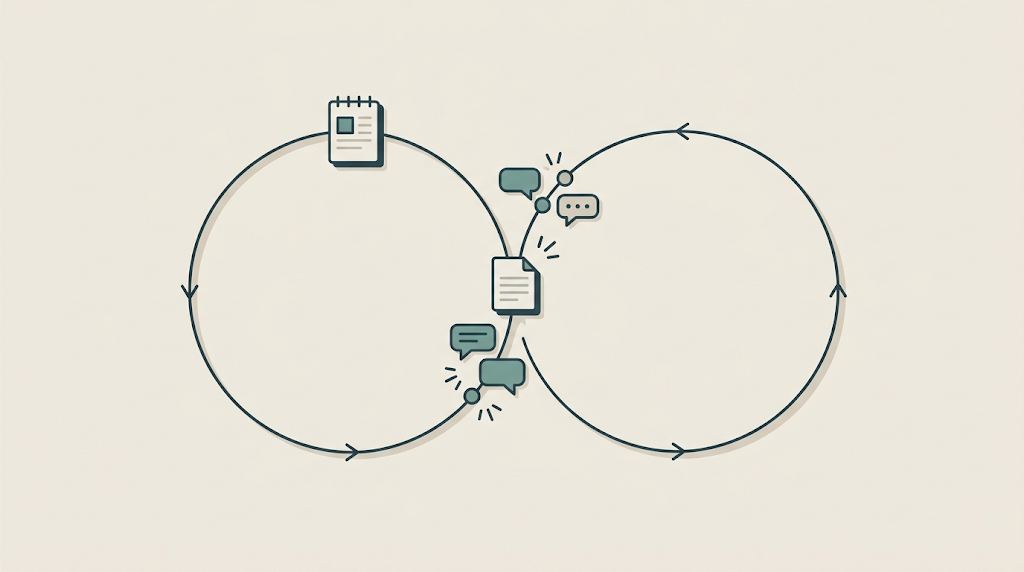
Most of the value of sharing shows up later, and I found one of the most useful ways to catch it: I keep the comments. When someone leaves a real response to something I published, I do not just read it and move on. I save it. That single habit turned into a loop that keeps feeding my writing.
Content creates assets
The idea underneath everything is that content creates assets. A post I write today can become a talk next quarter. A talk can become a Lunch & Learn. A Lunch & Learn can become a whole series, which is exactly what happened with this one. Hardly ever is something I put out a one-time thing. It is an asset that keeps paying off.
The same is true on the other side. The responses to that content are assets too. A comment is someone telling you what landed and what they are curious about, and that is the raw material for the next piece. Most people let that feedback evaporate. I have been trying to hold on to it.
Saving the comments
The habit is simple. When someone drops a comment on LinkedIn or BlueSky or Facebook, especially a substantive one, I copy it and paste it below the post in my vault. A reaction is a small signal. A comment is a real one, because the person took the time to say something. I want the real ones close by.
Sometimes I add a note next to the comment I saved. This is a good question, I might write, and I have thoughts I want to revisit. That note is a hook for a future post. The comment is not just feedback on what I already wrote. It is the beginning of the next thing. In fact, often times, as I respond to the comment, I already capture it as a source for a future post.
Mining the feedback
The loop only becomes powerful when I use the saved comments instead of just collecting them. Periodically, I ask my tools to look at the posts from the last month, find the ones that have captured feedback, and suggest new posts I could draw from that feedback.
That is where it compounds. I am not starting from a blank page wondering what to write about. I am starting from a set of real reactions from real people, and each one is a direction I already know someone cares about.
The Improving side works the same way. A post on the personal blog becomes a post on the Improving Thoughts blog. A comment there is a signal about what a client or a future reader found useful. I want to see those signals too, because they tell me what to double down on.
What the loop does for me
The feedback loop does two things at once. It gives me a steady stream of topics, so the well never runs dry. And it helps me know what is working, because the saved comments are real evidence. It is easy to convince yourself a post was great. It is harder to ignore a comment that says you missed something or a question you had not thought of.
There is a reason this habit fits with everything else I have described in this series. Reflection needs a system. The system does not stop at publishing. It extends to the reactions, because that is where the next round of reflection comes from. A post is the middle of a loop, not the end of one.
Feedback is a gift only if you keep it. The moment someone takes time to respond to something you shared, that response is worth holding onto, because it is a signal about something you might write next. Saving comments, adding a note to the good questions, and mining the collection later turns a scattered set of reactions into a working pipeline for new content.
The loop keeps the writing going in a way that starting from nothing never could. I am not chasing topics. I am listening to the people who are already engaged, and letting their questions become my next answers. Content creates assets, and the biggest asset is the conversation it starts.





Leave a Reply