
A short while before the Lunch & Learn, at a Build in Public session, a colleague and I were talking about knowledge management systems, second brains, that whole world. At some point, he said something that I have heard from him before, and it stuck with me the way a fair question does. He said my process did not work for him. Or, more precisely, that I did not really have a process, at least not a structured one someone else could follow.
That comment stayed with me. Not because I disagree, exactly. It made me wonder about something bigger: what is it that makes one person look at a process and say, yes, I can take something from this and make it my own, while another person looks at the same thing and says, I cannot follow that at all?
I shared this question with the group, and the conversation that followed gave me more than I expected. So let me try to work through it here, because I think it is also quietly about everything I have been sharing for ten years at Improving.
The creative lens
The first thing I noticed is that the people who took to my messy knowledge management system, who saw it and made it their own, tended to share a trait: a creative streak. I have one, and I recognize it in others.
When a creative mind looks at a process that is not quite right for it, it does not reject the process. It reads it differently. It says, this does not quite work for me, but I understand how it fits together, so I will do my thing there and adjust it there. The process becomes a starting point, not a contract. The person absorbs what they can, twists the rest, and ends up with something that works for them even if it no longer looks anything like the original.
I think that is a real difference, and it is one worth naming. A process is, by nature, an attempt to capture a sequence. But some of us do not naturally think in sequences. That is where the creativity comes in. The process is a scaffold, and the creative mind treats a scaffold as something to climb and then remodel, rather than something to live inside.
Different kinds of brains
The conversation in the room pushed past creativity, and I am glad it did, because the more I think about it, the more I believe the ability to adopt a process depends on the kind of brain doing the adopting.
There is a distinction worth drawing between systems and processes. A process asks you to behave a certain way in sequence. A system asks you to arrange your environment so that the behavior becomes easy. For some people, that second framing is the only one that lands. If the environment is set up right, the behavior follows without requiring a heroic act of will every single time. If you want to eat more protein, you do not need a process about cooking chicken. You need a station of ingredients within arm’s reach, in the same place as the tools you need, so that the easy choice and the right choice are the same. That is a system. The process falls out of it.
There is also a difference between visual thinkers and linear thinkers. A linear thinker can sit and follow a process from A to Z and see the connections. A visual thinker holds the whole shape of a thing at once. I have written before about visual thinking and how it bridges ideas, words, and images, and about being a visual thinker who finds insight by seeing it. For someone like me, a wall of sequential steps is almost the wrong format. What works is the shape.
I think the most useful way to think about this is through patterns: recognition, use, and creation. Do you recognize the pattern in what someone is showing you? Can you use it as it is? And if you cannot, can you create a new pattern that fits into the overall system? I recognize the patterns in the processes people share with me. I often cannot use them as written, because of how I think, how I learn, and how my preferences work. But I can create a pattern that fits me. That is not a failure of the process, and it is not a failure of me. It is just two different kinds of minds meeting.
A mess can still be a system
One of the things the conversation surfaced, and the thing I want to say directly, is that a system does not have to look clean to be right. Mine looks messy. I have notes in Obsidian, notes in Evernote, notes in the Notes app, recordings scattered around. To someone on the outside, that looks like no system at all. But there is a pattern to it, and it is a pattern I can navigate.
I think of it the way I think about my desk. My home office desk is a little chaotic. My wife will walk by and ask how I find anything in this. But I know exactly where things are. That one thing is under that pile of envelopes, and that pile has a place. From the outside it is a mess. From the inside, it is spatial memory. The thing is not the mess. The thing is that I can find what I need, when I need it, without losing the thread.
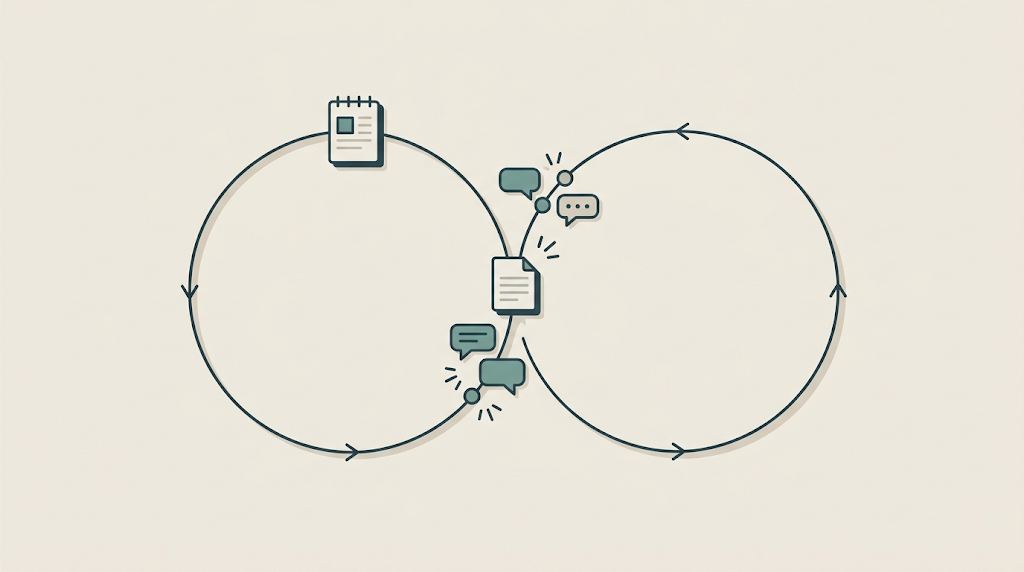
The lesson is to take a step back from the individual tools. Forget about the note in Evernote; that is not the point. Think about it as a box, and you know how that box connects to the other thing, even if you do not know what is inside it. In the AI work we have been doing, we talked about this as boxes and arrows. You have to identify all the boxes, and you have to see the arrows, and you do not necessarily know what goes into every box, but you need to know that they are there and how they connect.
That is the shape of my process. It is not a straight line. It is a map of boxes and arrows that I can read at a glance, even though someone else might look at it and see only clutter. Different minds work under different constraints, and the constraint that matters is not whether a process looks neat, but whether it fits the mind using it.
A process that keeps improving
There is one more habit worth naming, because it is how my own process gets better instead of going stale. Every time I edit a draft, I log what I changed and why. Over time that log becomes a record of the patterns I keep correcting. I can look back at it and ask my tools to find the things I keep telling them to fix, and turn that into a better instruction so I do not have to make the same edit again (this is still a work in progress).
That is the same “boxes and arrows” idea applied to the process itself. The process is not fixed. It is a thing I keep reading, finding the rough edge, and reshaping. The log is what lets me see the shape from the outside, the way I only see my desk as a mess until I realize I know exactly where everything is. Both are the same skill: holding a system loosely enough to keep improving it.
The people who cannot adopt a process are rarely being difficult, and the people who can are rarely being superior. They are just wired differently. Creativity is part of the picture, but so are systems versus processes, visual versus linear thinking, and whether you can recognize, use, or create the pattern in front of you.
This matters more than it might seem, because it is the reason sharing a method is not the same as sharing a result. Everything I have written across this series- the blogging workflow, the sharing culture, the way I capture my thoughts- is a set of boxes and arrows that happens to work for me. It is not a contract for anyone else to follow exactly. It is an invitation to look at the shape, keep what fits, and make the rest your own. That is the whole point of sharing a process at all: not to hand someone a path, but to help them see their own.



Leave a Reply