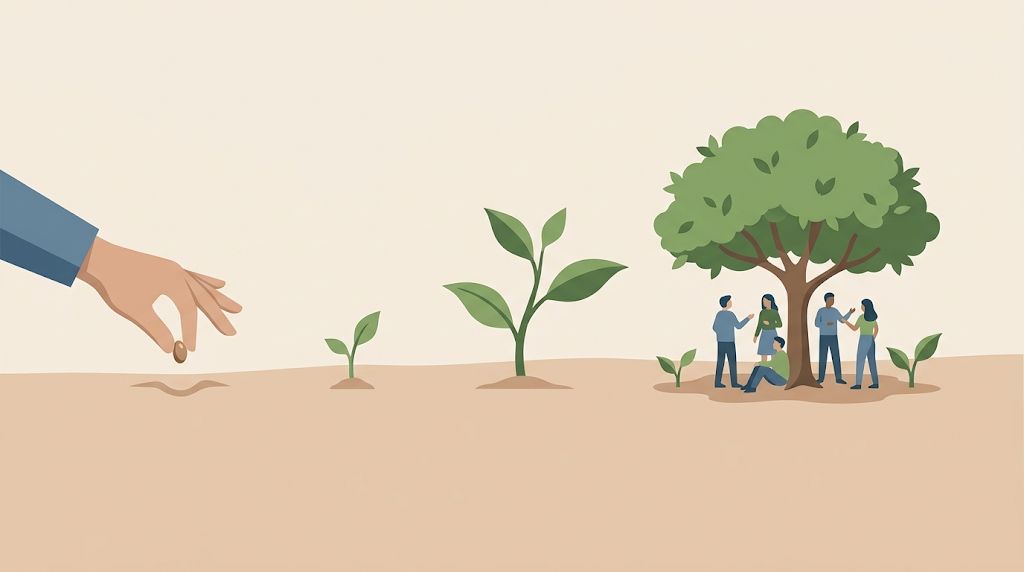
In the Build in Public session, someone asked me a question that took me straight back to a different era of my career. They pointed out that I had gotten lucky, in a sense, because Improving has sharing baked into its culture. Sharing is just something we do here, through ImprovingU, through The Learning Circle, through sessions like the one we were sitting in. Then they asked the harder question: what if you went to a place that did not have our standards? What would you do to plant something like this somewhere it does not already exist?
I have actually tried to do this. I have tried it in companies that had no such culture, and I have seen it fail and I have seen it slowly take. So let me tell you what I learned from the failures, because they are the useful part.
The first honest lesson: it starts with you, alone
Back in 2004, a project manager introduced me to the idea of a brown bag meeting. I had no idea what it was at the time, and when it clicked, it clicked: a bunch of people, a lunch, someone sharing something they had learned. The project manager noticed I was good at sharing and suggested I put it on the calendar. So I did.
For three or four months, I was the only one sharing.
People would say things like, “oh no, you are the specialist, we are just regular folks”. And I would try to tell them, you are not listening. I learned this thing this morning, and I am telling you about it right now. Anyone could do this. But it did not matter. It was not in their culture before I joined, and I was not going to flip a culture by holding a meeting and expecting people to show up differently than they ever had.
Leading by example did not work at first, and it did not work quickly. If you plan to start a sharing culture and have everyone join you by week two, that plan is wrong. The seed is the part that works. But it is a slow seed.
Share the small things, not the impressive things
Over time I learned something that changed how I approach this entirely: you do not plant the seed by showing off. You plant it by sharing the small, slightly embarrassing, very human things.
I noticed that people would say, “of course you share, you give talks at conferences, this is easy for you”. That framing makes sharing feel unattainable. So I made sure not to lead with the impressive stuff. I would make a point of sharing something I knew the people in the room knew far better than me. When I share something about AI these days, for example, I know the person across the table could explain it more precisely than I could. That is the point. I am not trying to be the expert. I am trying to model the behavior.
The version of this I use is the small thing. Not a talk on domain-driven design in a room where nobody has heard of it. A shortcut I just learned in the editor. A thing I just figured out this morning. Share the little things, so people get comfortable with the idea that whatever you learned today is worth saying out loud. I wrote about this exact dynamic in a post about why I shared our AI self-assessment lunch and learn: the point is not polish, it is progress. The struggle is the curriculum.
There is a second trick buried in there. When someone tells you they have not learned anything this week, ask them to tell you about their week anyway. Almost always, they hit a moment where they did not know something and had to go look it up. That is what you learned, I tell them. You learned what you do not know. Now you are aware of it, and you can go chase it. Once people realize that sharing is not about being an authority, the door opens. The reluctant expert is real, and most of us are one, quietly waiting for permission to share what we already know.
Lessons learned meetings, and the day I stopped having to go first
On a project we worked on, I introduced a lessons learned meeting. Just the small team, getting together to share the things we had learned that sprint. In the beginning, it started with me being the main one sharing. Same pattern as the brown bag, honestly. But I kept doing it, kept sharing the small things, kept planting.
And then it started to work. Over time, other people started sharing. It happened gradually, the way these things do.
There is one story I tell often, because it is the moment I knew the approach could outlive me. A colleague came out of that same project and went to a big corporate environment. He would tell me how much he missed the sharing, the lessons learned. It was a big company; people did not interact much, and they did not share lessons. And I told him what I had learned: just do it. Help people and say, hey, I have learned some things here, I am willing to share. See if anybody is interested.
So he did. He started a lessons learned meeting at a company where nothing like it existed. And for a while he was the one going first, the one sharing, the one keeping it alive. Then one day he told me something I always enjoy hearing from someone. He said, “Today I came in prepared to our lessons learned meeting, and I did not share anything. Somebody else started sharing. And when that person was done, the next person said, I think I know something you could try next”.
That is the whole goal, right there. The seed had become its own thing, and he no longer had to go first.
I have written about this in more detail in a post about lessons learned meetings and the leader who goes last. The title is the point. The leader does not go first forever. The leader goes first just long enough to inspire and help others lead.
You cannot build a sharing culture by declaration. You build it by being the one who shares the small thing, over and over, until someone else tries it, and then someone else, until the whole thing stops depending on you. It is slower than we want. It asks you to be comfortable being the only one sharing for a season. And it asks you to trust that the seed will grow even when you cannot see it from where you stand.
The colleague with the lessons learned meeting did not need me to build the culture for him. He needed one honest invitation, one model of what sharing the small things looks like, and the space to make it his own. That is the whole method. You cannot manufacture a sharing culture from the top. You can only plant it, one small thing at a time, and then get out of the way.





Leave a Reply