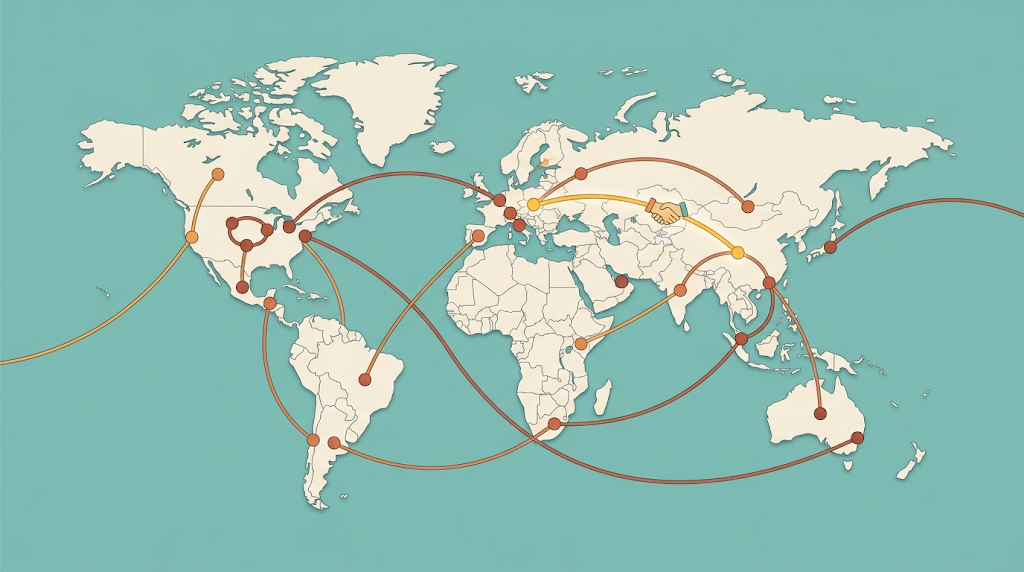
How do you actually find other Improvers who share your interests in a company as global as Improving? That’s what someone at Improving asked me. The annual in-person events are one thing, and so are the regular meetings. But what else have I found that connects people across offices and countries?
It’s a good question, because a global company can feel like a paradox. There are more people to meet than ever, but they’re scattered across time zones and screens. Finding your people takes a little intention. Over the last decade, I’ve watched, and taken part in, a handful of things that made it work.
The icebreaker bot
My favorite one started during the pandemic. Around 2020, when everyone was working remotely and trying to stay connected, we set up an icebreaker bot in the Teams channel. You signed up, and then every week you got paired with somebody else who had also signed up, from any office.
I remember the pairing would show up and I’d think, what’s that name? I don’t remember seeing that name. It’s this person from one of our Canadian offices, or our Mexican office, or someplace in sales. And that was great. I really enjoyed those conversations.
Here’s what I loved about it. We would talk about things that had nothing to do with work. And then you’d find out this person actually likes motorcycle racing, which is right up my alley. Or car racing, or Formula One. Or music. Or this person actually likes Brazilian music, which is funny because I don’t listen to a lot of Brazilian music despite being born and raised there.
The bot did something simple and powerful. It made the pairing random, which meant the connection wasn’t based on your project or your office. It was based on you as a person. That’s how you find your people.
Meeting online, then in person
The other thing I love is when the online connection becomes a real one. There’s a recognition program called Improving 100, and it brings Improvers together from all over the world. I wrote about that exact experience in Learning Out Loud, Then Meeting the People Who Were Listening. The short version: I met Improvers from several countries at an Improving 100 event, people I’d only ever seen as an on-screen presence, and then we were in person together.
That’s the pattern that works. You meet online first, through a talk or a bot or a shared interest, and then the in-person event turns the abstract connection into a handshake. It’s the same reason I keep giving virtual talks at Come Together, which runs across every office. A talk I give online reaches people I’d never otherwise meet, and then months later I bump into them at an in-person event and it clicks.
The in-person Come Together events are a whole separate thing worth mentioning. They’re where you finally get to see the culture that’s spread all over the world, all in one place. The person you’ve only ever seen in a video call is suddenly next to you at a table. Those events don’t just connect you to people. They make the global company feel like a neighborhood.
The talk that travels
One of the things I love about virtual talks is that they cross borders in a way in-person talks can’t. During Come Together, I gave talks and realized the people watching were in several different countries at once. I couldn’t see most of them, but they were there, listening from their own time zones and their own corners of the world.
That’s the pattern in a global company, too. You put something out there that reflects who you are, and the people who recognize it find their way to you. It doesn’t matter which office they’re in. The thing you shared is the thing that connects you.
I’ve even written about a Come Together virtual talk I gave on traveling, in Beyond the Aquarium: Finding Yourself by Leaving Home. That talk was about how human connection happens across countries, and it’s exactly the kind of thing these programs are for.
The recognition that ties it together
There’s a quieter way people find each other, too. It’s the recognition. When you do work that people notice, the work becomes a kind of magnet. I got nominations for Improving 100, and when I saw the things that came up, I had no idea people were seeing them that way. Some of the things people mentioned got no reaction when I first did them — no response. But a quiet reaction isn’t the same as nobody listening, and this is the same lesson: people absorb a talk or a post and act on it months later. The connection doesn’t always happen in real time. Sometimes it happens when someone finally tells you what you meant to them.
The lesson for finding your people
So if you’re new at a big company and wondering how to find the people who share your interests, here’s what I’d tell you. Sign up for the random things. Say yes to the bot, to the virtual talk, to the cross-office meeting. Put yourself out there before you know who’s listening.
And when someone shares something that makes you think, that makes you actually go do something, tell them. Let them know. That matters a lot. It’s the loop that keeps the connection alive across a company that’s spread all over the world.
Finding your people in a global company isn’t about being in the right office. It’s about being willing to be seen. The company builds the bot, the talks, the recognition, the events. But none of it works unless people actually show up and share who they are.
The icebreaker bot worked because enough people signed up. The virtual talks work because enough people give them. The recognition works because enough people do work worth noticing, and enough people take a moment to name it. It’s a crowd that builds itself, one person deciding to take part at a time.
I’ve been on this side of it for a decade, and the people who matter most to me here are the ones I met online first, as voices on a screen, and then turned into real friendships. The company gave us the ways to connect. We just had to use them.
Whether you’re brand new or have been here a while and still haven’t found your people, the move is the same. Say yes to the random pairing. Offer the talk. Reply to the person who shares something you care about. The company is big, which means your people are out there somewhere. It’s on you to make the first connection.



Leave a Reply